skip to main |
skip to sidebar
 TweakTown is reporting that ABit is leaving the motherboard market on 12/31/2008. Things have been bleak for the once beloved motherboard maker for quite some time, but with a lack of products shipping and all signs pointing towards failed product launches, the best outlooks are all pretty bleak. Perhaps ABit will be able to reorganize itself as a company hawking more consumer-oriented wares like Soyo... But with just a few weeks to go, the death watch awaits the news.
Unless things change, this will count for my eulogy. The recent boards were pretty much fine, but the fondness I have for the NF7-S v2.0 and BP6 does not fade with time. Of course, your capacitors did, but to be fair you were not alone...
This is going to be short as it's already covered well elsewhere and this is late... Microsoft has another out-of-band patch as of 12/17, MS08-078 affecting all versions of IE on all supported OSes except Server 2008 for IA-32/x64. Zero-day exploits are already going on. Get this one patched ASAP.
I'd normally say "use Firefox" or some other browser whenever possible, but Firefox and Opera are also currently suffering vulnerabilities. Firefox 3.0.5 resolves the issues. While not quite as sever as the zero-day exploit on IE, these are noteworthy as cross-platform.
I know this seems like a mundane task that most of us are admonished to do on a regular basis, but it really does need to be repeated: Blow your computers cases out once in a while, especially if they get dusty.
We all know that heat sinks and fans lose their effectiveness when dusty leading to potential overheating, but there's a worse possibility. I ran into a system last week that had dust bunnies in it-- nothing out of the ordinary, except that one of them had lodged itself into the video card's tiny fan. The user reported a blue screen indicating video driver failure. I was busy and asked him to reboot since this was a first time thing. He came back shortly after reporting that it happened again, and now the system couldn't POST. A single dust bunny had lodged in a tight fan, causing the fan to jam, burning out the motor. The video card (a Quadra, unfortunately) then overheated to the point of death. Odd stuff like this can absolutely happen, without showing general signs of overheating.
To be fair, the opposite is true. It's possible you might dislodge some conductive dust which might land in an inopportune spot, causing problems. That can typically be fixed pretty easily with a second cleaning. A burnt out video card, northbridge, etc. can be a lot more costly.
For all of you guys out there tasked with migrating users from a previous authentication domain (or workgroup) to a new domain know that when a user logs in with the new credentials, a new profile will be created and all of the user's previous settings and files will remain in the old profile.
You can go in after the fact and clean this up or use some other tricks (like using the FAST wizard, treating the old profile as the old computer and new profile as the new) but I've found something faster. I'm probably boneheaded for not hearing of this sooner, but I did a 7k workstation migration at an old job and they never tried anything this simple and relatively foolproof.
Go into Documents and Settings (typically on c:) and locate the Default User profile. It's hidden with stock XP settings, so you need to turn on the option to show hidden files and folders. Under normal circumstances, this profile gets stamped out as a template for new users. You can twiddle with this to make bulk changes to new users, but we'll use it for a slightly more nefarious purpose.
Go ahead and back up Default User, as we'll be replacing the entire profile. You never know-- you might want it later.
Take the user's existing profile and copy it, renaming it as... you guessed it, Default User.
Now go ahead and perform your domain migration. Upon first login, the user's old, familiar profile will 'stamp' itself into the new one. The only 'gotchas' are that you can only do this for one account per computer and if your users have limited drive space and large profiles, you might run short on hard drive space with essentially 3 copies of the profile hanging out there. Still, this is a very easy migration method, and you can remove the old copies once you're sure the user is happy with the migration.
This should work just fine on Windows 2000, and I assume Vista as well. I just haven't tested it.
GeekSmack has apparently found somebody willing to brave the wrath of Microsoft's lawyers, and broken cover with a video of Windows 7's boot screen. This doesn't really show much besides a slicker animation than Vista, but it does indicate serious progress if they're already tweaking the "nice to haves" vs. the core changes and updates.
Betas of Windows 7 are likely to be released in January, so a 2009 timetable for Windows 7 is starting to look a lot more likely.
OK, I'll admit the blog has been quiet of late. 2+ weeks without an update is inexcusable, so I might as well give the excuse. I was finally able to get an early Christmas present of a new Xbox 360. There's a tremendous back-catalog I'm going through now. Combine that with a fervor to finish out the last few PS2 games before the platform quiesces in January and a few other fun projects on the side, I would be busy enough...
But alas, I've been sick twice in the last month and on top of that slammed at work. I'll try to do better in future. In more fun news, Core i7 has been overclocked to 5510 MHz!!
This is a big week-- I've been tremendously busy with work and being sick lately, but stuff is happening with or without me. Core i7 released today, although motherboard and RAM prices will keep it from the mainstream for now. Tomorrow is the grand re-launch of the XBox360 with the New Xbox Experience.Exciting times!
PC World is reporting that a "mathematical breakthrough" combined with a method for forcing a router to give you lots of good samples of encrypted data allows for a non-dictionary attack against the TKIP encryption algorithm behind WPA. Researchers expect that WPA encryption can be cracked in 12-15 minutes given modern hardware. Combine that with a high power antenna, and you should be very concerned if you have routers and systems using WPA to carry sensitive data.
Aircrack-ng is already being updated to take advantage of the latest vulnerability, so this attack is in the wild now or will be shortly. (props to DownloadSquad for the info.)
As you should already know, WEP encryption is trivial to bypass, and while WPA2 isn't officially "cracked" yet, significant advancements in parallel processing using CUDA allow for much faster brute-force cracking of WPA2. That would still require a very high end system with lots of local storage over a 24+ hour period to crack, but the impractical is now possible.
So with anything below WPA2 being easily exploitable, using WiFi without additional encryption layers (SSH, VPN, etc.) is becoming too risky for any kind of sensitive data. Be careful out there...
It appears that at least two credible variants of worms based on the MS08-067 exploit have gone live.
I'm fully (and I do mean fully patched) and your organization should be too.
OK, so maybe this isn't the most high-level IT topic I've covered, but I've got to hand it to Amazon for trying to find a serious solution for a serious problem. They're working with manufacturers to eliminate overpackaged, hard-to-open containers for merchandise!
While on some level, Mother Nature is breathing a sigh of relief, there are also tangible benefits in terms of cost and frustration as well as weight. Heck, there's a closet-industry built up around devices to open modern blister packs!
In my day toys came in a cardboard box, possibly with some assembly required and with at most a small plastic window to see some of the contents inside. The current trend of exposing as much of the toy as possible in a demo mode is so ungodly frustrating to me that it makes me want to strangle kittens. Knowing that I'll be undoing half a roll of tape and a few dozen steel twist-ties is frustrating!
Just package the stuff in an appropriate, but not overdone package. A lot of computer stuff is already very lucky in this regard, but tons of consumer-oriented gear is not. Nobody is putting their greasy mitts on an Amazon product in a retail store. You don't have to compete with other items on the shelf. It's all going to ultimately come in a plain brown wrapper no matter what, so let's save time, material, plastic, frustration, etc. and see some more sensible packaging. Good job, Amazon! Keep it up.
I'm not going to rehash what's out there, and what's out there is still pouring in, but Core i7 is fast. Big surprise there. Here are some early reviews:Maximum PCTechSpotPC PerspectiveExpect mass-market acceptance by Q2-Q3 of '09, but with the Core i7 920 at around $270, that's tempting for a midrange + system now. i7 Xeon benchmarks are still MIA as far as I can tell, but expect similar performance.Shanghai will be good, but Intel has so much breathing room now... things are looking grim over at the green camp.
I don't normally beat the dead horse with Windows patch news, but this one is bad. Microsoft released an out-of-band patch this morning with MS08-067.This vulnerability affects all current shipping Windows versions, with worm-style propagation being a very real likelihood. Versions of Windows 2000 and XP Pre SP2 are highly vulnerable, with some XP SP2+ and Windows Server 2003 systems being exploitable under certain common/popular firewall conditions.
Vista and Server 2008 appear to be exploitable, but only in terms of a DDoS type attack. Remote Code Execution has not yet been shown on a Vista system.
As of 12:30 PM Pacific Time, Microsoft reports attacks in the wild. This could be the next Blaster/Sasser type attack, so get patching!
iFixit has a great page showing a teardown of the new MacBook and MacBook Pro for those of us who actually and unfortunately know what the inside of a notebook should look like.The big win? Hard drive replacement is MUCH easier on the new MacBooks Pros!The WTF moment? Neither a DisplayPort to VGA or DisplayPort to DVI adapter is included with your $2000+ computer. It's a $29 option from Apple. I have yet to see 3rd party alternatives, but no doubt they're coming, and for a fraction of that price. (Yeah, I know DisplayPort is the New Hotness, but there aren't any monitors for it yet...)
 Well, the product that started as Blackcomb, then codename Windows 7 will officially be called... (drum roll please)... Windows 7!
Never mind that it's a lot closer to a "6.1" version, this may mark the return to relatively sensible version naming at Microsoft.
Coincidence that Nehalem has been named i7? Windows 7 on i7? Sounds like a match made... somewhere.
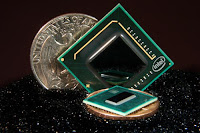 Intel just reported their best quarter ever with a gross margin of 59% while still selling most products at very competitive prices. The worst part? They don't expect the downturn to make that much of a dent by Q4. Even if things look bleaker long term, that's a helluva war chest.
Poor AMD.
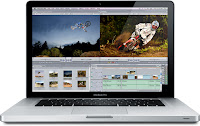 It's official. I'm not going to say anything that hasn't already been said, but Apple has refreshed its MacBook line as well as the MacBook Pro 15.4" and MacBook Air.
The old MacBook soldiers on as a slightly reduced cost base model, with rumors of an $899 model coming in below the current base model's $999 price.
The new MacBook is still in 13.3" flavor, but sports a new billet aluminum body & frame with an all-glass, no button touchpad. The touchpad is capable of up to 4-touch sensitivity and supports gestures. At least as importantly for the MacBook, Apple is going with an nVidia GeForce 9400M mobile chipset with integrated GPU. The non-legacy MacBooks now have a 'real' video solution that's acceptable for basic to moderate 3D use! Other nice features include LED backlighting and a backlit keyboad, but gone are the Firewire ports.
I'm not sure what the video output options are, but it looks like a DVI port is out, replaced by Apple's mini-DisplayPort. A breakout box here should do the DVI, VGA and possibly regular DisplayPort and HDMI connectors. We'll see as these start shipping as to what's available in the box.
This model is almost a bridge between the current MacBook Pro and the older MacBooks. They look much more similar and are in much closer parity in terms of design and content. Pricing should reflect this, as the "new" MacBooks are a little spendy relative to the models they replaced, and the older design is already discounted.
The MacBook Pro 15.4" shares all of the features of the MacBook, adding an option for a 9600M GPU for more serious graphics and FireWire is back, but only in FW800 flavor.
The MacBook Air was all-new this year already, so the changes are less dramatic. Options for bigger hard drives, faster CPUs and a speed-reduced 9400M have been announced. A mini-display port is available as well, but the Kensington lock port appears to still be MIA.
A 24" Apple Cinema Display LCD monitor to match the MacBook was also announced. It looks slick, sporting an LED backlight. Unfortunately, it's a bit rich for the current 24" market, coming in at $899.
What wasn't announced was a replacement (or price adjustment) for the current 17" MacBook Pro. For now, it soldiers on. A replacement is sure to be imminent.
Unsaid in all of this is what matters most to me: manageability! Easy replacement for hard drives, RAM, etc. remains up in the air. I suspect the new cases will still be a bitch to open and work with; the current MBPs are the bane of techs everywhere. The lack of Firewire leaves the Migration Assistant and Firewire Target mode in doubt. The Migration Assistant can work via other means, but I'm curious to see what 10.5.6 and beyond will offer to mitigate the loss of Firewire as a management and recovery tool.
OK, well this isn't news for anybody outside the US, but it is for us. Samsung has been competitive in the world notebook market for a while now, but back in the dim mists of time, they had agreed to be an OEM for Dell, and as such, left the US market alone. Engadget reports that the times, they are a changin'. The last Samsung-made Dell of any note was the Latitude X1, and before that, most of the small form factor Latitudes at least as far back as the Latitude LS. We haven't been able to even sample their larger offerings, and this is all-around good news for consumers.Sammy is entering the U.S. Netbook market at the same time with the NC10. This should open up some competition among "premium" netbooks.
It looks like Intel is trying to block the AMD/Foundry deal-- AMD and Intel cross license each others' Intellectual Property very heavily and they object. This would transition some Intel IP to probably be used by Foundry, and Intel and Foundry do not cross-license. I expect this to get a little legally ugly here, as Intel has the upper hand. If AMD pulls x86-64, that would really hurt Intel, but without x86, AMD is deader than dead.
Well, it's official. AMD is spinning this pretty hard, but they are selling all of their Fabs and will no longer be manufacturing their own CPUs. AMD sold off all of their Fabs worldwide in a deal with ATIC -- Advanced Technology Investment Corporation. ~3000 AMD employees will transition to the new company/joint venture which will be named Foundry.
The Inquirer is already dubbing the joint venture Arabian Micro Devices, and I can't say that I disagree. I'm concerned that this is funded ultimately through ATIC by the Emirate of Abu Dhabi itself. Yes, AMD will retain 45% share in stock, but if things turn sour the already troubled chipmaker is now at the mercy of the new managers of its former Fabs as well.
Obviously a lot of chipmakers operate in a fabless manner. I've had some experience with Silicon Labs-- a company that has never owned or operated a Fab, but still does OK for itself. Certainly the advantage is that you don't have to specialize in desiging, building and operating the Fab itself in a manner that recoups your huge facility investments in the most efficient manner possible. That frees you up to concentrate on design and be more agile... but it also prevents you from having any direct control of Fab outputs. Not getting enough ICs? Bad yields? They can't just shuffle production around by fiat to get the outputs they need.
If this were such a positive deal, why wouldn't AMD have gone for this 5 years ago, when Fabless started to become the new awesome thing? They were already having problems with their own fabrication processes. Chartered Semiconductor is already doing Fabrication for them as a partner, and ATI produces their chips through TSMC. This is a clear sign of desperation to be doing it now, and they're lucky to have found a suitor willing to take on ~$1.3 billion in debt along with a $700 million set of fabrication assets.
I've got to admit, I'm a little nostalgic at the news. I lived a few blocks from the K5 Fab (Fab 25) as it was spinning up in the mid 90's. I sat at the bus stop many a day and watched AMD hotshots drive past in their Lotus Esprits. Those days are not to return.
 In response to a question about using LinkedIn
"It's like Pokemon for ex coworkers. Gotta catch em all!"
Download Squad had a great article recently listing 24 open-source, free tools for admins and technicians. I'm already sold on PuTTY, DBAN, Memtest86/Memtest86+ and 7-Zip, but there are some real gems out there that I hadn't even heard of.
WCD in particular scratches an itch I've had since giving up Norton ncd many a year ago and being spoiled by locate under *nix. You do need to know how to manually set a Path variable, but otherwise it works as advertised.
They did have one recommendation that is good, but I think you can do better... Visualization tools for data are invaluable in giving you a meaningful picture (literally) of what is and is not taking up space. They recommend a product called WinDirStat.
WinDirStat looks like a re-working of the same concept that was pioneered by SequoiaView: "Cushion Treemaps" to visualize data. The strength of this method is that it can show individual files and folders easily by size and type, and groups them together, but the weakness is that it lacks a true hierarchical view. It's also a very busy interface which makes it hard to tell usage in terms of rough percentages or amounts. Unfortunately, SequoiaView lacks any type of obvious licensing. You're probably safe to use it for any purpose, but it's not OSS. It's also rapidly aging, so WinDirStat looks like a great replacement.
There are times when it is the best tool for the job, but for a first-pass on a Windows system I prefer an application called Scanner, written buy a guy named Steffan Gerlach. The licensing is also unclear, but presumed freeware with the source supplied. This app has the strength of being able to show disk usage as a pie chart, with a hierarchical view. It lacks color coding by file and doesn't show individual files at all until you drill down into that directory. It is, however, nice and portable, so you can run it from a USB drive or a network share.
Between the two, you should have pair of complementary products that'll allow you to better manage your storage.
I'll get this out there right up front: I'm not a fan of HP notebooks. Partially, becuase I've had limited exposure and find their model lineup frustratingly complex and partially because what experience I've had has tended to be dealing with reliability/repair issues on the cheap consumer models.
Still, I've finally been able to get a good decoder for the business line:
First number
6 = mid-range business
8 = high end
2 = ultraportable
Second number:
The higher the 2nd number the better generally, it denotes a market segment.
Third number:
year
10 = 2007
30 = 2008
4th number:
0 = Intel
5 = AMD
Final position: code letters:
s = cheap/value edition - lower end screen, no docking connector except USB solutions
b = mainstream business
p = professional business e.g. 6910p, 8510p
w = mobile workstation e.g. 8510w 8710w
If somebody has a better way to decode models, I'm all ears.
 LCD prices for all types of panels have been contracting recently, but I'm very impressed with how much you can get for so little nowadays. I went shopping for a presentation display for work and brought an LG LG70 42" TV/Display. This is still a somewhat cost-reduced model when compared with flagship-style Sony products, but for $1099, I got a 42" 1080P screen that works flawlessly when hooked up to a computer via VGA. The TV detected the input immediately and asked if I wanted to "enjoy" this new connection now. The screen was set up immediately, correctly, and absolutely no waves, jaggies, dead/stuck pixels or "snow" were evident when using VGA. If I didn't know better, I would have sworn it was a digital signal.
My only beef is the dark, sparkly red stripe around the outside of the unit. It hides all of the buttons except for power and frankly looks a bit too "boy racer."
All in all, I'm very impressed at what's out there now for so little. If only I had the money for one of my own... it would make a kicking monitor.
As with many things Apple, The Jobs and crew like to bless a lot of common projects before distributing versions on the Mac. Recently, however, I came across some problems with the Apple distribution of X11 (an optional component on the OS disk) on 10.5.4. When launched, the App would appear in the dock, then disappear, then reappear again a few times. Checking the running processes, it started then entered a zombie state almost immediately-- before any logs get written.
The first system was a fairly modern MacBook Pro, but had a user profile that was migrated from a PPC Powerbook. Thinking this may be the problem, I uninstalled and then reinstalled X11 to no avail from the OS disk. I stepped through all kinds of diagnosis, running updates, clearing caches, checking all the config and shell profile files with no luck. I finally stumbled on a suggestion to try the XQuartz version of X11. Apple uses the XQuartz project as a basis for building their X11 distribution, but apparently don't do a good job all the time. The XQuartz version dropped right in and works great. The only downdside was that it requires a logoff.
The problem occurred the very next day for me on a PPC Mac running 10.5.4, so the problem may be something in the OS or configs we use. It doesn't appear to be platform-based. The same fix worked like a charm.
As some further notes, Apple may overwrite X11 with their point-releases of their OS, so reinstallation may be necessary at a later date. The X11 version, however, was last changed at 10.5.2, and was unchanged with the 10.5.3 and 10.5.4 releases.
Just a quickie-- There are tons of Linux newbie guides on the 'net, but I found one that I like. The pages at linuxcommand.org show you not only the 'right' way to do things (starting with command line, pretty much distro-agnostic), but guide you on what you should know without a *nix basis.





 Posts
Posts

